
-
How to get started
- General set-up
- DMA & ESRS
- EU-Taxonomy
- CO2-Footprinting
- Supply Chain Sustainability
- VSME
-
ESRS
- ESRS - Overview
-
DMA Double Materiality
- The Double Materiality Proc...
- Double Materiality Assessme...
- Start or import your Double...
- Copying a Double Materialit...
- Transferring Data from an E...
- Add and manage stakeholders
- How to involve stakeholders...
- Which stakeholders to invol...
- Select your relevant sustai...
- Add the impacts, risks and ...
- Upload IROs into the DM pro...
- Assess each impact, risk an...
- Step-by-Step: How to Create...
- Understand your Double Mate...
- Set common definitions for ...
- Consolidation / Determinati...
- Change materiality levels o...
- Assessment Scales: Configur...
-
DMA Double Materiality - IR...
- Agriculture and Farming
- Forestry
- Construction and Engineering
- Energy Production & Uti...
- Water & Waste Services
- Casinos & Gaming
- Leisure Facilities
- Capital Markets
- Banking
- Insurance
- Health Care
- Food & Beverage Services
- Hotels & Lodging
- Aerospace & Defence
- Automobiles & Other Tra...
- Biotechnology & Pharmac...
- Building Products & Fur...
- Chemicals & Biofuels
- Construction Materials
- Electronics
- Food & Beverages
- Machinery & Equipment
- Medical Equipment & Ser...
- Metal Processing
- Oil & Gas - Midstream &...
- Pulp, Paper & Wood prod...
- Textiles, Apparels, Footwea...
- Tobacco
- Toys, Sporting Goods & ...
- Coal Operations
- Gap Analysis
-
ESRS Data Collection & ...
- Create a new ESRS report
- Include Your Double Materia...
- Copy data from an existing ...
- Copy data from an existing ...
- Importing CO2 Data into an ...
- ESRS report, step 1: determ...
- ESRS report, step 1 (1): om...
- ESRS report, step 2: prepar...
- ESRS report, step 2 (1): Da...
- ESRS report, step 2 (2): Di...
- ESRS report, step 3: collec...
- ESRS report, step 3 (1): Un...
- ESRS report, step 3 (1): Un...
- ESRS report, step 4: writin...
- Mapping of Sustainability T...
- Download datapoints
- Consolidating ESRS Reports
- Audits: Review and Compare ...
- Analysis & Dashboard
- Guide to Handling Requests ...
-
EU Taxonomy
- Data collection
- Eligibility assessment
- Minimum safeguards
- Alignment assessment
- Adding financial data for E...
- Accounting standards
- Analytics & Reporting
-
CO2 Footprint
- CO2 - Overview
- Data Collection
- Activities
-
Scopes
- Scope 1 - Emissions from so...
- Scope 2 - Emissions that re...
- (2) Scope 2-Emissions: Mark...
- Scope 3.1 - Emissions assoc...
- Scope 3.2 - Emissions assoc...
- Scope 3.3 - Emissions resul...
- Scope 3.4 - Emissions assoc...
- Scope 3.5 - Emissions assoc...
- Scope 3.6 - Business Travel
- Scope 3.7 - Employee commuting
- Scope 3.8 - Emissions resul...
- Scope 3.9 - Emissions gener...
- Scope 3.10 - Emissions gene...
- Scope 3.11 - Emissions gene...
- Scope 3.12 - Emissions gene...
- Scope 3.13 - missions resul...
- Scope 3.14 - Franchises
- Scope 3.15 - Investments
- How to assign scopes (in th...
- Scope 3.4 and Scope 3.9: Ca...
- Scope 3 Reporting: Process,...
- Emission factors
- Old flow
-
Supply chain risk
- Module settings
- Supplier management
- Risk assessment
- Grievance mechanism
- Incidents
- Reporting
- Information for suppliers
- Guide to Handling Requests ...
-
VSME
-
VSME Data Collection & ...
- VSME Module – Roles & P...
- Create a new VSME report
- Importing CO2 Data into a V...
- VSME - Basic Module
- VSME - Comprehensive Module
- VSME report, step 1: Determ...
- VSME report, step 2: Prepar...
- VSME report, step 2 (1): Da...
- VSME report, step 2 (2): Di...
- VSME report, step 2 (3): Us...
- VSME report, step 2 (4): Co...
- VSME report, step 3: collec...
- VSME report, step 4: writin...
- Reusing ESRS Data for Your ...
- Sustainability Profile
-
VSME Data Collection & ...
-
General settings and config...
- Account Settings
- Log-in process
- General User Management
- Data requests, review and v...
- Reporting Structure
-
Product & Regulatory up...
-
Software Updates
- EQS Software updates: 4. Se...
- EQS Software Updates: 12. J...
- EQS Software Updates: 13. M...
- EQS Software Updates: 21. A...
- Simplified ESRS Draft in th...
- EQS Software Updates: 25. M...
- EQS Software Updates: 12. M...
- EQS Software Updates 6. Mar...
- EQS-Software Updates: 24. F...
- EQS-Software Updates: 8. Ja...
- Introducing ESRS Consolidat...
- EQS-Software Updates: 10. N...
- EQS-Software Updates: 24. O...
- EQS-Software Updates: 22. S...
- Updates to the VSME Module:...
- CO₂ Workflow Update
-
Regulatory Updates
- EQS Regulatory Update: 19. ...
- EQS Regulatory Updates: 17....
- EQS Regulatory Updates: 25....
- EQS-Regulatory Updates 13. ...
- EQS-Regulatory Updates 15. ...
- EQS Regulatory Updates 24. ...
- EQS Regulatory Updates 10. ...
- EQS Regulatory Updates 13. ...
- EQS-Regulatory Updates 23. ...
- EQS-Regulatory Updates 28. ...
- EQS-Regulatory Updates 8. J...
- Sustainability Knowledge
-
Software Updates
-
Reduction Planner
- Reduction Planner
Double Materiality Assessment under the ESRS Simplified Draft
Modified on Tue, 28 Apr at 10:41 AM
The ESRS Simplified Draft was published by EFRAG as part of the Omnibus initiative. The aim of this draft is to significantly simplify the existing ESRS requirements and make them more practical for companies.
As part of this draft, changes have also been made to the methodology of the Double Materiality Assessment (DMA). These affect both the structure of sustainability matters as well as the assessment logic and the overall analytical approach. This article explains the key changes and their impact on conducting the DMA in the Sustainability Cockpit.
Important: The ESRS Simplified Draft is currently still in draft status. Further changes to its structure and methodology are possible.Overview: What is changing?
Compared to the ESRS Delegated Act 2023, the DMA under the Simplified Draft is:
- less granular
- methodologically simplified
- more strategically oriented
The main changes relate to:
- the structure of sustainability matters
- the assessment of impacts (severity)
- the handling of time horizons
- the methodological approach (top-down vs. bottom-up)
1. Sustainability matters: Simplified structure
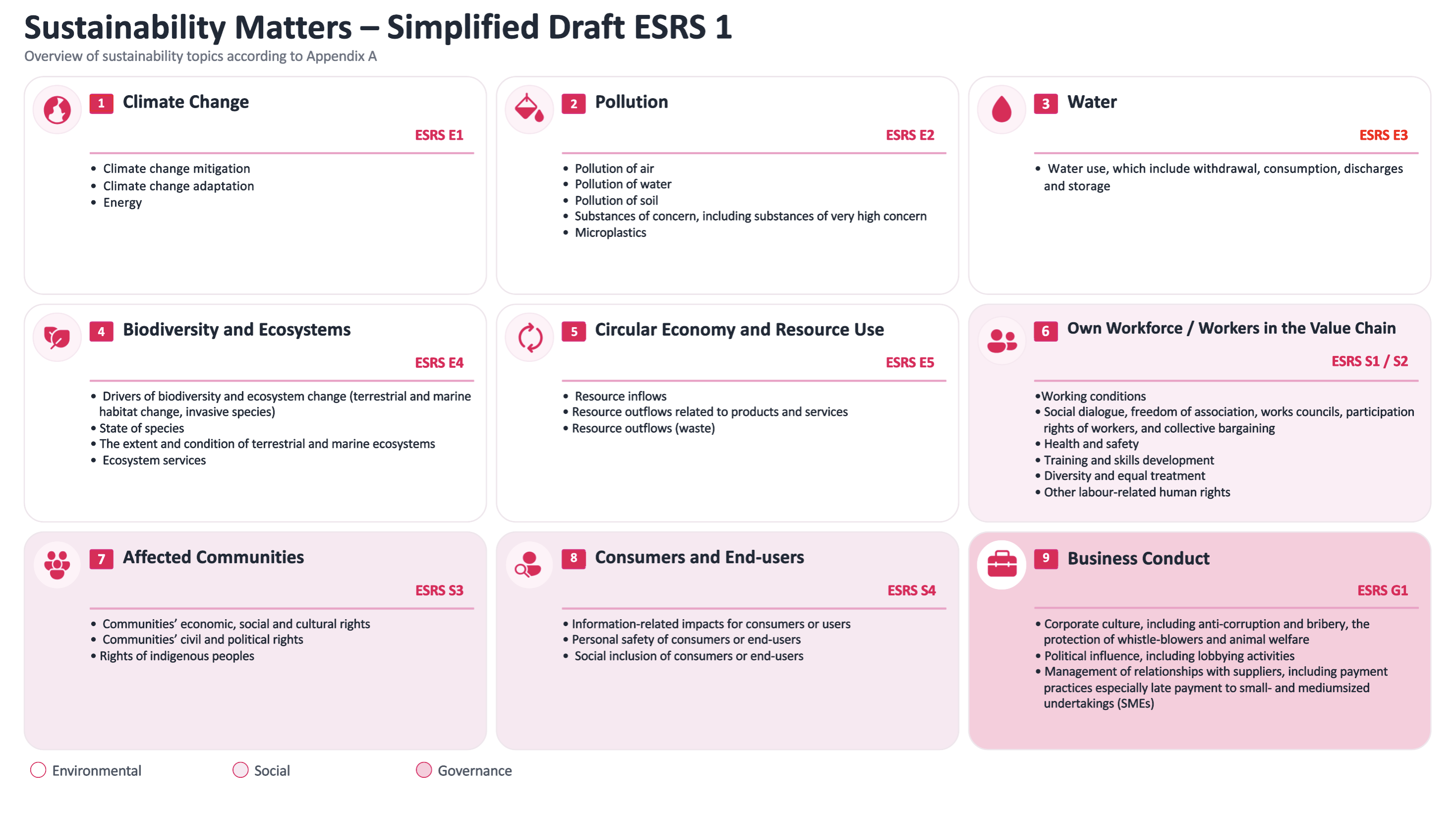
The sustainability matters under the Simplified Draft are based on ESRS 1 Appendix A.
Compared to the Delegated Act:
- sub-sub-topics have been removed
- several topics have been merged
- overall complexity has been reduced
Examples:
Detailed sub-topics such as
“Working conditions – adequate wages” or “work-life balance” are no longer assessed separately.
Social topics in particular have been significantly consolidated.
2. Simplified assessment of severity
A key change concerns the assessment of impacts. Previously, this was based on the criteria scale, scope and irremediability – all three had to be assessed together.
Under the Simplified Draft: Each criterion can independently determine materiality.
From a logic perspective, this means: Materiality can already be triggered if a single criterion exceeds the defined threshold
3. Time horizons become optional
Previously, specifying time horizons (short-, medium-, long-term) was a mandatory part of identifying an IRO.
Under the Simplified Draft: The time dimension is optional. It is only required if relevant for the assessment.
Impact in the tool: IROs can be created without assigning a time horizon
4. Shift towards a stronger top-down approach
The Simplified Draft introduces an important conceptual shift in how the DMA can be conducted. In addition to the traditional bottom-up approach, a top-down approach is now explicitly supported and strengthened.
Under the top-down approach, materiality is not primarily derived from individual IROs, but instead assessed at the level of sustainability matters.
This involves analysing overarching factors such as:
- the company’s business model
- its strategic direction
- relevant sectors
- geographic areas of operation
- the structure of the value chain
Based on this analysis, companies can already form a well-founded view of which sustainability matters are likely to be material.
A combination with the bottom-up approach remains possible.
| Top-down | Bottom-up |
|---|---|
| Starts at topic level | Starts with individual IROs |
| Strategic perspective | Detailed assessment |
| Faster overview | Higher level of detail |
What do these changes mean for conducting the DMA?
Overall, the Simplified ESRS Draft leads to a noticeable streamlining of the Double Materiality Assessment – not only in individual methodological aspects, but across the entire process.
Where the previous approach was strongly focused on identifying and assessing as many individual IROs as possible in detail, the new approach enables a more targeted and pragmatic execution. The emphasis shifts towards efficiently identifying and prioritising relevant issues, rather than ensuring maximum granularity across all potential topics.
At the same time, the assessment itself becomes more flexible. Companies can rely more on well-founded expert judgement without necessarily having to perform detailed quantitative analyses for every aspect. This is particularly beneficial in early stages of the assessment or where data availability is limited.
Finally, the DMA becomes more closely aligned with the actual business context. The focus is on those topics that arise from the company’s business model, activities and operating environment, and that may lead to significant impacts or financial risks and opportunities.
In practice, this means a more focused, efficient and business-oriented DMA that concentrates on what truly matters.
Was this article helpful?
That’s Great!
Thank you for your feedback
Sorry! We couldn't be helpful
Thank you for your feedback
Feedback sent
We appreciate your effort and will try to fix the article