
Reduction targets define how an organization plans to reduce its greenhouse gas emissions over time. At first glance, they often appear as simple commitments — for example, “reduce emissions by 42% by 2030.” In practice, however, they play a much more fundamental role.
A reduction target is not just a number. It is the central reference point for all decarbonization activities within a company.
Without a clearly defined target, sustainability efforts tend to remain fragmented. Individual measures may be implemented — such as switching to renewable energy or improving efficiency — but without a common direction, it becomes difficult to assess whether these actions are sufficient or how they contribute to an overall goal.
By contrast, a well-defined target provides:
- A clear direction for emission reductions
- A benchmark against which progress can be measured
- A foundation for prioritizing measures and investments
In this sense, reduction targets turn sustainability from a set of isolated initiatives into a structured management process.
What defines a reduction target in practice?
In practical terms, every reduction target is based on three core elements:
- A baseline, which defines the starting point (e.g. emissions in 2023)
- A target level, which defines the intended reduction (e.g. -42%)
- A target year, which defines the timeframe (e.g. 2030)
Importantly, a target is not just an end value. It implicitly defines a reduction pathway, which determines how quickly emissions must decrease year by year. This pathway becomes critical when assessing whether a target is realistic and how it can be achieved.
How companies decide on the right target
Choosing a reduction target is not about selecting a percentage in isolation. It is a structured process shaped by:
- External frameworks (especially SBTi)
- Internal capabilities and constraints
- Emission structure (Scopes and categories)
In practice, companies make three key decisions.
1. Defining the level of ambition
The first decision is how ambitious the target should be.
Many companies align with the Science Based Targets initiative (SBTi), which ensures that targets are consistent with global climate goals. SBTi defines minimum ambition levels based on 1.5°C pathways and does not allow companies to set weaker targets if they want validation.
For near-term targets, this typically results in reductions of:
- Approximately 40–50% over a 10-year period (for absolute emissions)
This makes SBTi-aligned targets:
- Highly credible externally
- More demanding internally
In practice, organizations often differentiate between:
- External targets (e.g. SBTi-aligned, fixed and validated)
- Internal planning targets (used to test feasibility and scenarios)
2. Defining scope coverage
The second decision concerns which emissions are included.
Emissions are categorized into:
- Scope 1: direct emissions
- Scope 2: purchased energy
- Scope 3: value chain emissions
SBTi requires:
- Full coverage of Scope 1 and 2
- Inclusion of Scope 3 if it represents ≥40% of total emissions
In addition:
- Near-term Scope 3 targets must cover at least 67% of Scope 3 emissions
- Long-term targets must cover up to 90%
In practice, Scope 3 often represents the largest share of emissions, making it essential for meaningful reduction targets — even though it is more difficult to influence.
3. Choosing the target type and method
Most companies define absolute reduction targets, which reduce total emissions by a fixed percentage.
This aligns with the most widely used SBTi method:
- Absolute Contraction Approach (ACA)
→ Reduces emissions in line with global carbon budgets
Alternative methods include:
- Sectoral Decarbonization Approach (SDA)
→ Sector-specific pathways based on physical activity - Intensity targets
→ Used in specific cases (e.g. high-growth sectors)
In practice:
→ Absolute targets are the standard and recommended approach.
SBTi requirements in detail
When aligning with SBTi, target setting follows a rule-based framework. Targets must meet strict criteria across several dimensions.
Base year and emissions inventory
SBTi requires companies to define a clear and representative base year, supported by a complete greenhouse gas inventory.
This includes:
- Scope 1, 2, and relevant Scope 3 emissions
- Calculation according to the GHG Protocol
- Consistent methodology over time
Any structural changes (e.g. acquisitions) require recalculation of the baseline.
Target timeframe
SBTi distinguishes between two types of targets:
Near-term targets (mandatory)
- Time horizon: 5–10 years
- Purpose: drive immediate reductions
Long-term targets (Net Zero)
- Target year: no later than 2050
- Requirement: reduce emissions by ~90–95%
Target ambition
Targets must should align with 1.5°C pathways, which define the minimum required reduction level.
This means:
- Companies cannot define lower ambition levels and still be validated
- Reduction rates are effectively predefined by climate science
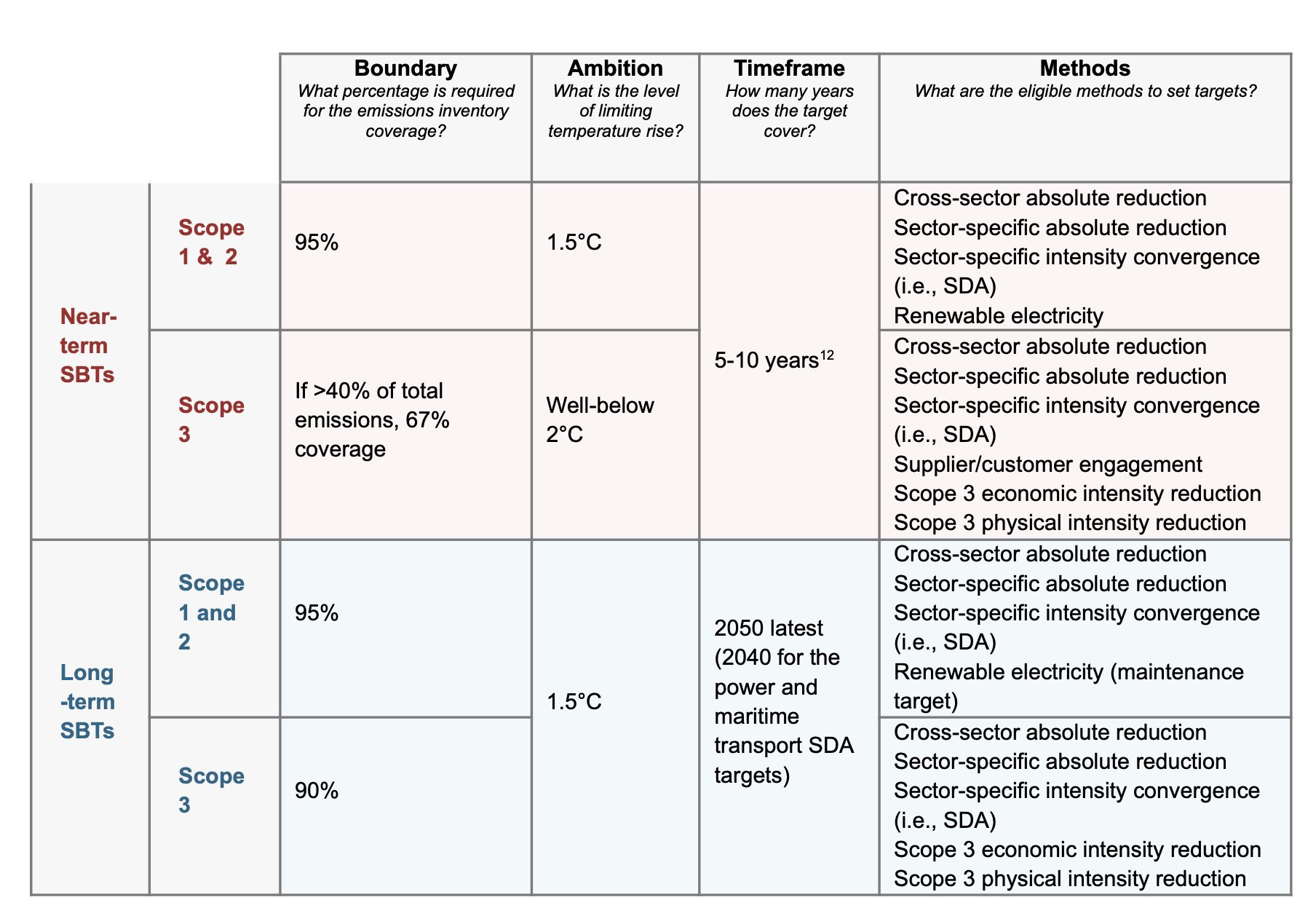
Source: SBTi Net Zero Standard V1.3.1, p. 30.
Scope-specific requirements
- Scope 1 and 2 must always be included
- Scope 3 must be included if material
- Separate considerations apply for:
- Energy-related emissions (Scope 2)
- Value chain emissions (Scope 3)
Methodological requirements
Targets must follow approved SBTi methods, including:
- Absolute contraction
- Sector-specific pathways
- Approved intensity approaches
All assumptions must be:
- Transparent
- Documented
- Reproducible
Sector-specific pathways
Not all sectors decarbonize in the same way. SBTi accounts for this by providing sector-specific guidance and pathways.
These are particularly relevant for industries such as:
- Energy
- Transport
- Cement and steel
- Buildings
Sector-specific approaches (e.g. SDA) define:
- Different reduction speeds
- Different benchmarks
- Different calculation methods
Practical implication
A company in a high-emission sector may:
- Have stricter or more tailored reduction requirements
- Need to follow a sector-specific methodology
This means:
→ Target setting must reflect industry-specific realities, not just generic percentages.
FLAG emissions (Forest, Land and Agriculture)
A special category within SBTi is FLAG emissions, which apply to companies in sectors such as:
- Agriculture
- Forestry
- Food production
- Land-intensive industries
What makes FLAG emissions different?
FLAG emissions include:
- Land-use change
- Deforestation
- Agricultural emissions
These emissions behave differently from fossil emissions and are therefore treated separately.
SBTi requirements for FLAG
Companies with significant FLAG emissions must:
- Set separate FLAG targets
- Follow FLAG-specific pathways
- Address:
- Deforestation
- Land-use practices
- Agricultural processes
Practical implication
If your company operates in a FLAG-relevant sector:
- You cannot combine all emissions into one target
- You must define:
- A standard emissions target (Scopes 1–3)
- A separate FLAG target
From target to operational planning
Once a target is defined, it must be translated into concrete planning inputs.
This includes:
- Converting percentages into absolute emissions
- Defining a reduction pathway over time
- Comparing required reductions with actual measures
This is where many organizations encounter challenges:
- Targets are defined correctly
- But not linked to implementation
How the Reduction Planner supports this process
The Reduction Planner connects formal target setting with operational execution.
It enables you to:
- Define targets in line with SBTi requirements
- Visualize reduction pathways over time
- Link targets to specific measures
- Compare planned reductions with required reductions
- Identify gaps and adjust your strategy
More about setting Reduction Targets in the Reduction Planner here.
Was this article helpful?
That’s Great!
Thank you for your feedback
Sorry! We couldn't be helpful
Thank you for your feedback
Feedback sent
We appreciate your effort and will try to fix the article