
-
How to get started
- General set-up
- DMA & ESRS
- EU-Taxonomy
- CO2-Footprinting
- Supply Chain Sustainability
- VSME
-
ESRS
- ESRS - Overview
-
DMA Double Materiality
- The Double Materiality Proc...
- Double Materiality Assessme...
- Start or import your Double...
- Copying a Double Materialit...
- Transferring Data from an E...
- Add and manage stakeholders
- How to involve stakeholders...
- Which stakeholders to invol...
- Select your relevant sustai...
- Add the impacts, risks and ...
- Upload IROs into the DM pro...
- Assess each impact, risk an...
- Step-by-Step: How to Create...
- Understand your Double Mate...
- Set common definitions for ...
- Consolidation / Determinati...
- Change materiality levels o...
- Assessment Scales: Configur...
-
DMA Double Materiality - IR...
- Agriculture and Farming
- Forestry
- Construction and Engineering
- Energy Production & Uti...
- Water & Waste Services
- Casinos & Gaming
- Leisure Facilities
- Capital Markets
- Banking
- Insurance
- Health Care
- Food & Beverage Services
- Hotels & Lodging
- Aerospace & Defence
- Automobiles & Other Tra...
- Biotechnology & Pharmac...
- Building Products & Fur...
- Chemicals & Biofuels
- Construction Materials
- Electronics
- Food & Beverages
- Machinery & Equipment
- Medical Equipment & Ser...
- Metal Processing
- Oil & Gas - Midstream &...
- Pulp, Paper & Wood prod...
- Textiles, Apparels, Footwea...
- Tobacco
- Toys, Sporting Goods & ...
- Coal Operations
- Gap Analysis
-
ESRS Data Collection & ...
- Create a new ESRS report
- Include Your Double Materia...
- Copy data from an existing ...
- Copy data from an existing ...
- Importing CO2 Data into an ...
- ESRS report, step 1: determ...
- ESRS report, step 1 (1): om...
- ESRS report, step 2: prepar...
- ESRS report, step 2 (1): Da...
- ESRS report, step 2 (2): Di...
- ESRS report, step 3: collec...
- ESRS report, step 3 (1): Un...
- ESRS report, step 3 (1): Un...
- ESRS report, step 4: writin...
- Mapping of Sustainability T...
- Download datapoints
- Consolidating ESRS Reports
- Analysis & Dashboard
- Guide to Handling Requests ...
-
EU Taxonomy
- Data collection
- Eligibility assessment
- Minimum safeguards
- Alignment assessment
- Adding financial data for E...
- Accounting standards
- Analytics & Reporting
-
CO2 Footprint
- CO2 - Overview
- Data Collection
- Activities
-
Scopes
- Scope 1 - Emissions from so...
- Scope 2 - Emissions that re...
- (2) Scope 2-Emissions: Mark...
- Scope 3.1 - Emissions assoc...
- Scope 3.2 - Emissions assoc...
- Scope 3.3 - Emissions resul...
- Scope 3.4 - Emissions assoc...
- Scope 3.5 - Emissions assoc...
- Scope 3.6 - Business Travel
- Scope 3.7 - Employee commuting
- Scope 3.8 - Emissions resul...
- Scope 3.9 - Emissions gener...
- Scope 3.10 - Emissions gene...
- Scope 3.11 - Emissions gene...
- Scope 3.12 - Emissions gene...
- Scope 3.13 - missions resul...
- Scope 3.14 - Franchises
- Scope 3.15 - Investments
- How to assign scopes (in th...
- How to specify the scope
- Scope 3 Reporting: Process,...
- Emission factors
- Old flow
-
Supply chain risk
- Module settings
- Supplier management
- Risk assessment
- Grievance mechanism
- Incidents
- Reporting
- Information for suppliers
- Guide to Handling Requests ...
-
VSME
-
VSME Data Collection & ...
- VSME Module – Roles & P...
- Create a new VSME report
- Importing CO2 Data into a V...
- VSME - Basic Module
- VSME - Comprehensive Module
- VSME report, step 1: Determ...
- VSME report, step 2: Prepar...
- VSME report, step 2 (1): Da...
- VSME report, step 2 (2): Di...
- VSME report, step 2 (3): Us...
- VSME report, step 2 (4): Co...
- VSME report, step 3: collec...
- VSME report, step 4: writin...
- Reusing ESRS Data for Your ...
- Sustainability Profile
-
VSME Data Collection & ...
-
General settings and config...
- Account Settings
- Log-in process
- General User Management
- Data requests, review and v...
- Reporting Structure
-
Product & Regulatory up...
-
Software Updates
- EQS Software Updates: 12. J...
- EQS Software Updates: 13. M...
- EQS Software Updates: 21. A...
- Simplified ESRS Draft in th...
- EQS Software Updates: 25. M...
- EQS Software Updates: 12. M...
- EQS Software Updates 6. Mar...
- EQS-Software Updates: 24. F...
- EQS-Software Updates: 8. Ja...
- Introducing ESRS Consolidat...
- EQS-Software Updates: 10. N...
- EQS-Software Updates: 24. O...
- EQS-Software Updates: 22. S...
- Updates to the VSME Module:...
- CO₂ Workflow Update
-
Regulatory Updates
- EQS Regulatory Update: 19. ...
- EQS Regulatory Updates: 17....
- EQS Regulatory Updates: 25....
- EQS-Regulatory Updates 13. ...
- EQS-Regulatory Updates 15. ...
- EQS Regulatory Updates 24. ...
- EQS Regulatory Updates 10. ...
- EQS Regulatory Updates 13. ...
- EQS-Regulatory Updates 23. ...
- EQS-Regulatory Updates 28. ...
- EQS-Regulatory Updates 8. J...
- Sustainability Knowledge
-
Software Updates
-
Reduction Planner
About Carbon Price and how to use it
Modified on Fri, 17 Apr at 12:08 PM
What is Carbon Pricing?
Carbon pricing refers to assigning a monetary value to greenhouse gas emissions (CO₂e) in order to make their economic impact visible. It is a key instrument for integrating climate considerations into business decision-making.
There are two main types:
- External carbon pricing
Legally defined prices (e.g. EU Emissions Trading System – EU ETS or national carbon taxes) - Internal carbon pricing
Company-defined prices used to guide investment and strategic decisions
While external pricing ensures compliance, internal carbon pricing enables companies to actively steer their transformation.
The European Commission describes the EU ETS as a central carbon market instrument in Europe, while the World Bank’s Carbon Pricing Dashboard provides a global overview of existing carbon pricing systems.
Carbon Pricing as a strategic instrument
Carbon pricing is more than just a reporting mechanism — it is a core decision-making model.
When used effectively, it helps to:
- steer investments
- assess climate-related risks financially
- anticipate future regulatory developments
- prioritize decarbonization measures
CDP defines internal carbon pricing as a monetary value assigned to emissions to guide decisions related to climate risks, opportunities, and investments. The WBCSD also highlights that internal carbon pricing helps bridge financial and climate perspectives.
The key mindset shift:
Emissions become costs — and reductions become economic value.
The three strategic roles of Carbon Pricing
Risk pricing | Companies assess potential future regulatory carbon costs for emission-intensive activities. This is particularly relevant with evolving systems such as EU ETS and ETS2. |
Steering price | An internally defined price is used to actively influence investment, procurement, and technology decisions. |
Transformation price | Companies use higher-than-market prices to reflect long-term Net Zero pathways and accelerate decarbonization. The IEA’s Net Zero scenarios are often used as a reference for such forward-looking price assumptions. |
How to set a carbon price
There is no single “correct” carbon price. In practice, companies typically combine multiple approaches:
1. Market-based prices
- Based on real market data (e.g. EU ETS)
- Suitable for short-term decision-making
2. Science-based prices
- Aligned with climate targets (e.g. Net Zero pathways)
- Often significantly higher (e.g. 100–300 €/t CO₂e long-term)
- Supports SBTi-aligned strategies
3. Internal steering prices
- Freely defined values for internal decision-making
- Often combined with increasing price pathways over time
Historical development: EU ETS carbon prices
For many companies, the EU ETS is the most relevant external benchmark. Its development illustrates why carbon pricing must be approached strategically rather than purely operationally.
| Year | Price level (€/t CO₂e) | Context |
|---|---|---|
| 2005–2007 | ~0–30 € | Initial phase |
| 2008–2012 | ~5–25 € | Financial crisis |
| 2013–2017 | ~3–10 € | Oversupply |
| 2018 | ~15–25 € | Market reforms |
| 2019 | ~25–30 € | Stabilization |
| 2020 | ~20–35 € | COVID impact |
| 2021 | ~50–80 € | Strong increase |
| 2022 | ~70–100 € | Energy crisis |
| 2023 | Peak ~105 € | All-time high |
| 2024–2026 | ~70–90 € | High but stable level |
Where to find carbon pricing information
For a reliable overview, companies should combine official sources, market data, and strategic references:
Regulatory sources
- European Commission – Carbon Markets
- European Commission – Market Stability Reserve
- EEX – EU ETS Auctions
- World Bank – Carbon Pricing Dashboard
Market data
Carbon Pricing in the Reduction Planner
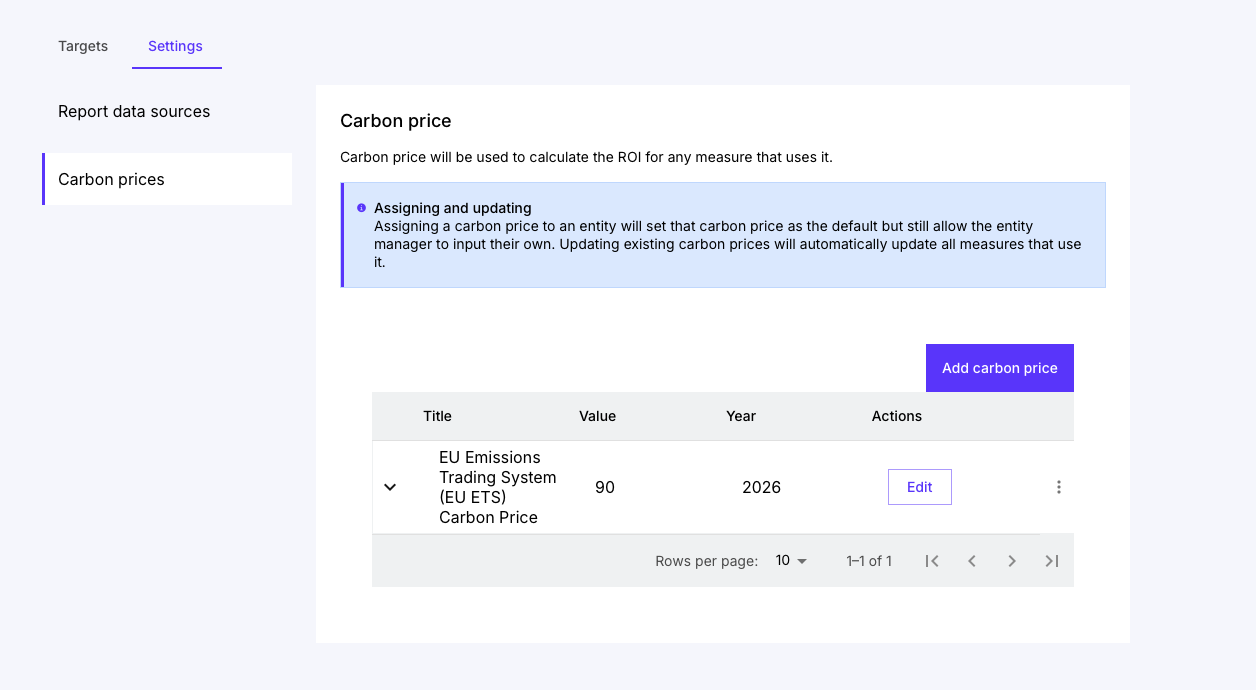
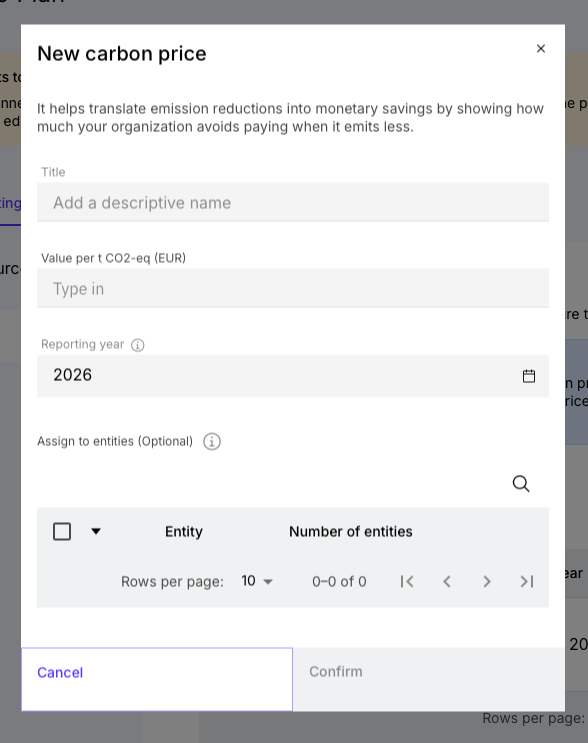
Within the Reduction Planner, carbon pricing can be transparently documented and directly used for decision-making.
The key advantage is that carbon prices are not just stored — they are integrated into the evaluation of measures.
Tool capabilities:
- Define multiple carbon prices
- Model different scenarios
- Use carbon pricing for measure evaluation and ROI calculations
Linking Carbon Pricing to measures and ROI
Carbon pricing enhances traditional financial analysis.
Without carbon pricing:
- Focus on investment and operating costs
With carbon pricing:
- Additional component: avoided carbon costs
Example:
A measure reduces:
- 1,000 t CO₂e per year
- Carbon price: 100 €/t
→ Value of reduction: 100,000 € per year
Strategic value within the tool
By combining:
- measures
- scenarios
- carbon pricing
you can:
- make robust investment decisions
- simulate future price developments
- compare measures objectively
- transparently document your climate strategy
Carbon pricing is a key lever of modern climate strategies.
Within the Reduction Planner, it becomes a practical tool:
Emissions are translated into costs — making climate action economically manageable and comparable.
Was this article helpful?
That’s Great!
Thank you for your feedback
Sorry! We couldn't be helpful
Thank you for your feedback
Feedback sent
We appreciate your effort and will try to fix the article