
-
How to get started
- General set-up
- DMA & ESRS
- EU-Taxonomy
- CO2-Footprinting
- Supply Chain Sustainability
- VSME
-
ESRS
- ESRS - Overview
-
DMA Double Materiality
- The Double Materiality Proc...
- Double Materiality Assessme...
- Start or import your Double...
- Copying a Double Materialit...
- Transferring Data from an E...
- Add and manage stakeholders
- How to involve stakeholders...
- Which stakeholders to invol...
- Select your relevant sustai...
- Add the impacts, risks and ...
- Upload IROs into the DM pro...
- Assess each impact, risk an...
- Step-by-Step: How to Create...
- Understand your Double Mate...
- Set common definitions for ...
- Consolidation / Determinati...
- Change materiality levels o...
- Assessment Scales: Configur...
-
DMA Double Materiality - IR...
- Agriculture and Farming
- Forestry
- Construction and Engineering
- Energy Production & Uti...
- Water & Waste Services
- Casinos & Gaming
- Leisure Facilities
- Capital Markets
- Banking
- Insurance
- Health Care
- Food & Beverage Services
- Hotels & Lodging
- Aerospace & Defence
- Automobiles & Other Tra...
- Biotechnology & Pharmac...
- Building Products & Fur...
- Chemicals & Biofuels
- Construction Materials
- Electronics
- Food & Beverages
- Machinery & Equipment
- Medical Equipment & Ser...
- Metal Processing
- Oil & Gas - Midstream &...
- Pulp, Paper & Wood prod...
- Textiles, Apparels, Footwea...
- Tobacco
- Toys, Sporting Goods & ...
- Coal Operations
- Gap Analysis
-
ESRS Data Collection & ...
- Create a new ESRS report
- Include Your Double Materia...
- Copy data from an existing ...
- Copy data from an existing ...
- Importing CO2 Data into an ...
- ESRS report, step 1: determ...
- ESRS report, step 1 (1): ph...
- ESRS report, step 2: prepar...
- ESRS report, step 2 (1): Da...
- ESRS report, step 2 (2): Di...
- ESRS report, step 3: collec...
- ESRS report, step 3 (1): Un...
- ESRS report, step 3 (1): Un...
- ESRS report, step 4: writin...
- Mapping of Sustainability T...
- Download datapoints
- Consolidating ESRS Reports
- Audits: Review and Compare ...
- Analysis & Dashboard
- Guide to Handling Requests ...
-
EU Taxonomy
- Data collection
- Eligibility assessment
- Minimum safeguards
- Alignment assessment
- Adding financial data for E...
- Accounting standards
- Analytics & Reporting
-
CO2 Footprint
- CO2 - Overview
- Data Collection
- Activities
-
Scopes
- Scope 1 - Emissions from so...
- Scope 2 - Emissions that re...
- (2) Scope 2-Emissions: Mark...
- Scope 3.1 - Emissions assoc...
- Scope 3.2 - Emissions assoc...
- Scope 3.3 - Emissions resul...
- Scope 3.4 - Emissions assoc...
- Scope 3.5 - Emissions assoc...
- Scope 3.6 - Business Travel
- Scope 3.7 - Employee commuting
- Scope 3.8 - Emissions resul...
- Scope 3.9 - Emissions gener...
- Scope 3.10 - Emissions gene...
- Scope 3.11 - Emissions gene...
- Scope 3.12 - Emissions gene...
- Scope 3.13 - missions resul...
- Scope 3.14 - Franchises
- Scope 3.15 - Investments
- How to assign scopes (in th...
- Scope 3.4 and Scope 3.9: Ca...
- Scope 3 Reporting: Process,...
- Emission factors
- Old flow
-
Supply chain risk
- Module settings
- Supplier management
- Risk assessment
- Grievance mechanism
- Incidents
- Reporting
- Information for suppliers
- Guide to Handling Requests ...
-
VSME
-
VSME Data Collection & ...
- VSME Module – Roles & P...
- Create a new VSME report
- Importing CO2 Data into a V...
- VSME - Basic Module
- VSME - Comprehensive Module
- VSME report, step 1: Determ...
- VSME report, step 2: Prepar...
- VSME report, step 2 (1): Da...
- VSME report, step 2 (2): Di...
- VSME report, step 2 (3): Us...
- VSME report, step 2 (4): Co...
- VSME report, step 3: collec...
- VSME report, step 4: writin...
- Reusing ESRS Data for Your ...
- Sustainability Profile
-
VSME Data Collection & ...
-
General settings and config...
- Account Settings
- Log-in process
- General User Management
- Data requests, review and v...
- Reporting Structure
-
Product & Regulatory up...
-
Software Updates
- EQS Software updates: 4. Se...
- EQS Software Updates: 12. J...
- EQS Software Updates: 13. M...
- EQS Software Updates: 21. A...
- Simplified ESRS Draft in th...
- EQS Software Updates: 25. M...
- EQS Software Updates: 12. M...
- EQS Software Updates 6. Mar...
- EQS-Software Updates: 24. F...
- EQS-Software Updates: 8. Ja...
- Introducing ESRS Consolidat...
- EQS-Software Updates: 10. N...
- EQS-Software Updates: 24. O...
- EQS-Software Updates: 22. S...
- Updates to the VSME Module:...
- CO₂ Workflow Update
-
Regulatory Updates
- EQS Regulatory Update: 19. ...
- EQS Regulatory Updates: 17....
- EQS Regulatory Updates: 25....
- EQS-Regulatory Updates 13. ...
- EQS-Regulatory Updates 15. ...
- EQS Regulatory Updates 24. ...
- EQS Regulatory Updates 10. ...
- EQS Regulatory Updates 13. ...
- EQS-Regulatory Updates 23. ...
- EQS-Regulatory Updates 28. ...
- EQS-Regulatory Updates 8. J...
- Sustainability Knowledge
-
Software Updates
-
Reduction Planner
- Reduction Planner
How ROI is calculared for Reduction Measures
Modified on Tue, 8 Sep at 11:05 AM
.
Decarbonization is no longer only an environmental objective; it has increasingly become a financial and strategic business decision. Companies must determine which measures should be implemented first, which investments will generate long-term value, and which actions are necessary to comply with regulatory requirements or mitigate future cost risks. To support well-informed decision-making, the module enables companies to evaluate reduction measures based on their Return on Investment (ROI).
The ROI calculation is based on several financial and emissions-related factors. First, the investment costs (CapEx) of a measure are considered, such as expenditures for new equipment, infrastructure upgrades, or technology transitions. In addition, operational expenditures (OpEx) are included, for example maintenance costs, additional energy consumption, or operating expenses associated with new technologies.
These costs are compared with the direct financial savings generated by the measure. Such savings may include reduced energy expenses due to efficiency improvements, lower material consumption, or avoided compliance costs related to regulatory requirements such as emissions certificates or carbon taxes.
Another key component of the evaluation is the monetary value of avoided emissions. This value is calculated using a defined carbon price. Companies can apply either an internal carbon price, which is often used as a strategic steering instrument for investment decisions, or an external price aligned with regulatory carbon markets such as the EU Emissions Trading System (EU ETS). By monetizing emission reductions, the climate benefit of a measure is translated directly into economic terms.
Overall, the calculation therefore considers several elements: investment costs, ongoing operational costs, direct cost savings, and the financial impact of avoided emissions. The carbon price—whether internally defined or based on regulatory markets—is configured in the settings of the reduction plan and serves as the basis for evaluating emission reductions from a financial perspective.
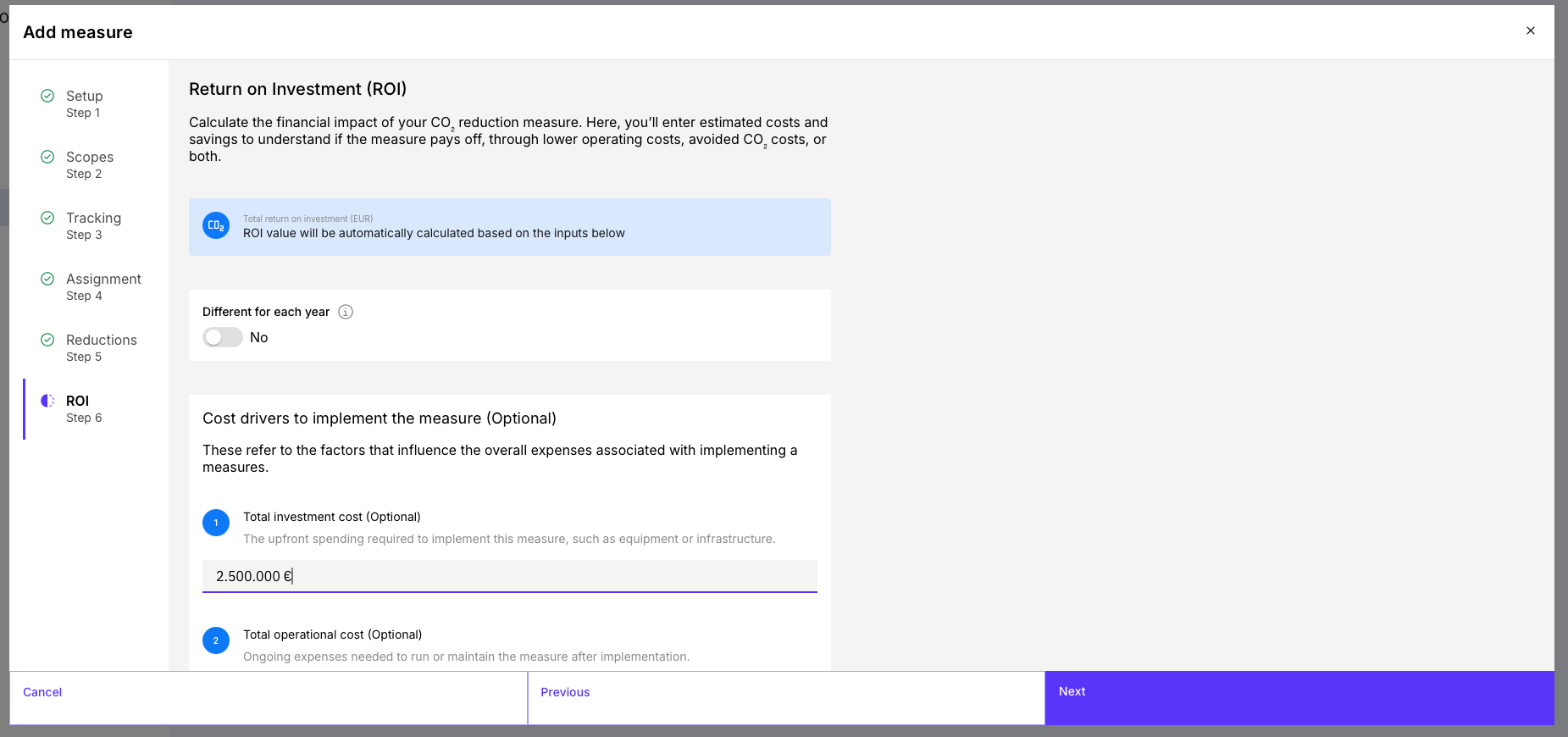
The system first calculates the expected avoided emissions per year based on the reduction values defined for the respective measure. These avoided emissions are then multiplied by the configured carbon price to estimate the monetary value of the climate impact. Direct cost savings are added to this value, and the total investment and operational costs are subsequently deducted. The result represents the net economic impact of the measure and forms the basis for calculating the ROI.
Beyond the ROI calculation, this logic also allows companies to assess abatement costs, meaning the cost per tonne of CO₂ avoided. This metric is widely used in corporate decarbonization strategies to compare and prioritize different mitigation measures. Measures with low or even negative abatement costs—often referred to as “no-regret measures”—are particularly attractive because they both reduce emissions and generate financial savings.
The calculation is not limited to individual measures. It is also aggregated at scenario level. When multiple measures are combined into a scenario, the system sums their emission reductions as well as their financial impacts. This allows companies to compare different transformation pathways—for example a conservative scenario focused on incremental efficiency improvements versus a more ambitious pathway involving structural changes in energy supply or supply chains.
This integrated evaluation of emissions impact and financial performance is essential for embedding decarbonization into corporate decision-making. It enables companies to prioritize investments, make climate-related risks more transparent, and credibly demonstrate progress toward regulatory frameworks such as CSRD or voluntary commitments like Science Based Targets. By linking emissions data, operational measures, and financial analysis, decarbonization becomes not only a sustainability initiative but a core component of strategic planning and capital allocation.
Was this article helpful?
That’s Great!
Thank you for your feedback
Sorry! We couldn't be helpful
Thank you for your feedback
Feedback sent
We appreciate your effort and will try to fix the article