
-
How to get started
- General set-up
- DMA & ESRS
- EU-Taxonomy
- CO2-Footprinting
- Supply Chain Sustainability
- VSME
-
ESRS
- ESRS - Overview
-
DMA Double Materiality
- The Double Materiality Proc...
- Double Materiality Assessme...
- Start or import your Double...
- Copying a Double Materialit...
- Transferring Data from an E...
- Add and manage stakeholders
- How to involve stakeholders...
- Which stakeholders to invol...
- Select your relevant sustai...
- Add the impacts, risks and ...
- Upload IROs into the DM pro...
- Assess each impact, risk an...
- Step-by-Step: How to Create...
- Understand your Double Mate...
- Set common definitions for ...
- Consolidation / Determinati...
- Change materiality levels o...
- Assessment Scales: Configur...
-
DMA Double Materiality - IR...
- Agriculture and Farming
- Forestry
- Construction and Engineering
- Energy Production & Uti...
- Water & Waste Services
- Casinos & Gaming
- Leisure Facilities
- Capital Markets
- Banking
- Insurance
- Health Care
- Food & Beverage Services
- Hotels & Lodging
- Aerospace & Defence
- Automobiles & Other Tra...
- Biotechnology & Pharmac...
- Building Products & Fur...
- Chemicals & Biofuels
- Construction Materials
- Electronics
- Food & Beverages
- Machinery & Equipment
- Medical Equipment & Ser...
- Metal Processing
- Oil & Gas - Midstream &...
- Pulp, Paper & Wood prod...
- Textiles, Apparels, Footwea...
- Tobacco
- Toys, Sporting Goods & ...
- Coal Operations
- Gap Analysis
-
ESRS Data Collection & ...
- Create a new ESRS report
- Include Your Double Materia...
- Copy data from an existing ...
- Copy data from an existing ...
- Importing CO2 Data into an ...
- ESRS report, step 1: determ...
- ESRS report, step 1 (1): ph...
- ESRS report, step 2: prepar...
- ESRS report, step 2 (1): Da...
- ESRS report, step 2 (2): Di...
- ESRS report, step 3: collec...
- ESRS report, step 3 (1): Un...
- ESRS report, step 3 (1): Un...
- ESRS report, step 4: writin...
- Mapping of Sustainability T...
- Download datapoints
- Consolidating ESRS Reports
- Audits: Review and Compare ...
- Analysis & Dashboard
- Guide to Handling Requests ...
-
EU Taxonomy
- Data collection
- Eligibility assessment
- Minimum safeguards
- Alignment assessment
- Adding financial data for E...
- Accounting standards
- Analytics & Reporting
-
CO2 Footprint
- CO2 - Overview
- Data Collection
- Activities
-
Scopes
- Scope 1 - Emissions from so...
- Scope 2 - Emissions that re...
- (2) Scope 2-Emissions: Mark...
- Scope 3.1 - Emissions assoc...
- Scope 3.2 - Emissions assoc...
- Scope 3.3 - Emissions resul...
- Scope 3.4 - Emissions assoc...
- Scope 3.5 - Emissions assoc...
- Scope 3.6 - Business Travel
- Scope 3.7 - Employee commuting
- Scope 3.8 - Emissions resul...
- Scope 3.9 - Emissions gener...
- Scope 3.10 - Emissions gene...
- Scope 3.11 - Emissions gene...
- Scope 3.12 - Emissions gene...
- Scope 3.13 - missions resul...
- Scope 3.14 - Franchises
- Scope 3.15 - Investments
- How to assign scopes (in th...
- Scope 3.4 and Scope 3.9: Ca...
- Scope 3 Reporting: Process,...
- Emission factors
- Old flow
-
Supply chain risk
- Module settings
- Supplier management
- Risk assessment
- Grievance mechanism
- Incidents
- Reporting
- Information for suppliers
- Guide to Handling Requests ...
-
VSME
-
VSME Data Collection & ...
- VSME Module – Roles & P...
- Create a new VSME report
- Importing CO2 Data into a V...
- VSME - Basic Module
- VSME - Comprehensive Module
- VSME report, step 1: Determ...
- VSME report, step 2: Prepar...
- VSME report, step 2 (1): Da...
- VSME report, step 2 (2): Di...
- VSME report, step 2 (3): Us...
- VSME report, step 2 (4): Co...
- VSME report, step 3: collec...
- VSME report, step 4: writin...
- Reusing ESRS Data for Your ...
- Sustainability Profile
-
VSME Data Collection & ...
-
General settings and config...
- Account Settings
- Log-in process
- General User Management
- Data requests, review and v...
- Reporting Structure
-
Product & Regulatory up...
-
Software Updates
- EQS Software updates: 4. Se...
- EQS Software Updates: 12. J...
- EQS Software Updates: 13. M...
- EQS Software Updates: 21. A...
- Simplified ESRS Draft in th...
- EQS Software Updates: 25. M...
- EQS Software Updates: 12. M...
- EQS Software Updates 6. Mar...
- EQS-Software Updates: 24. F...
- EQS-Software Updates: 8. Ja...
- Introducing ESRS Consolidat...
- EQS-Software Updates: 10. N...
- EQS-Software Updates: 24. O...
- EQS-Software Updates: 22. S...
- Updates to the VSME Module:...
- CO₂ Workflow Update
-
Regulatory Updates
- EQS Regulatory Update: 19. ...
- EQS Regulatory Updates: 17....
- EQS Regulatory Updates: 25....
- EQS-Regulatory Updates 13. ...
- EQS-Regulatory Updates 15. ...
- EQS Regulatory Updates 24. ...
- EQS Regulatory Updates 10. ...
- EQS Regulatory Updates 13. ...
- EQS-Regulatory Updates 23. ...
- EQS-Regulatory Updates 28. ...
- EQS-Regulatory Updates 8. J...
- Sustainability Knowledge
-
Software Updates
-
Reduction Planner
- Reduction Planner
Grouping Emission Activities Within a Scope
Modified on Wed, 9 Sep at 4:44 PM
With the Grouping feature, you can organize related emission activities within a Scope and evaluate them together. A group functions as an additional structuring and analysis level within your calculation.
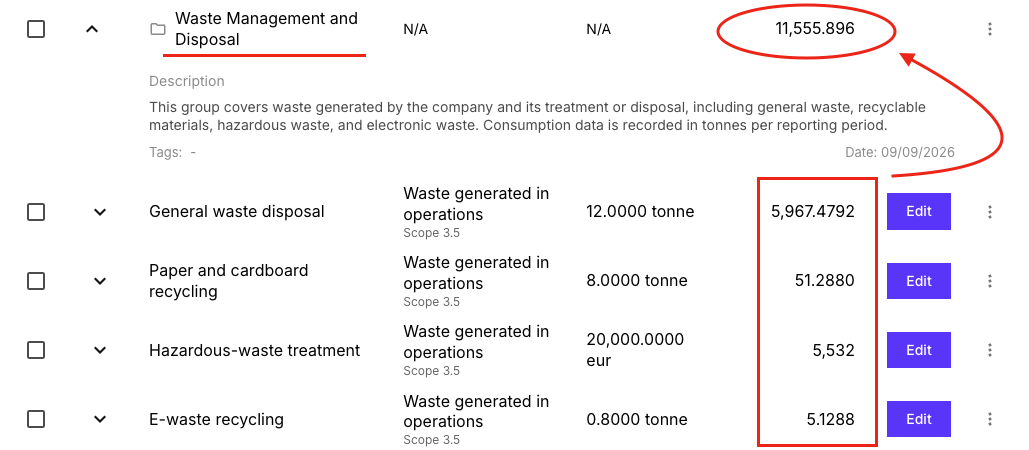
In addition to providing a clearer overview, the emissions of all activities within a group are automatically added together and displayed as group emissions. This allows you to analyze emissions not only at the level of individual activities or Scopes, but also to compare different groups with one another.
When are groups useful?
Use groups when you want to consider several independent activities within the same Scope together, for example:
- different types of fruit within the group “Imports from EU countries”;
- waste activities categorized by disposal method;
- individual business trips within a travel project;
- activities associated with a specific site or product line;
- different products, suppliers, or business areas within a Scope.
A group is particularly useful when activities are related from a business perspective but should be recorded and calculated separately. Activities within a group can use different emission factors and calculation bases. The individual activities continue to be calculated separately; their emissions are then combined into a single group value.
Creating and populating a group
- Open the relevant organizational unit.
- Navigate to the overview of emission activities.
- Create a new group and assign it a unique name.
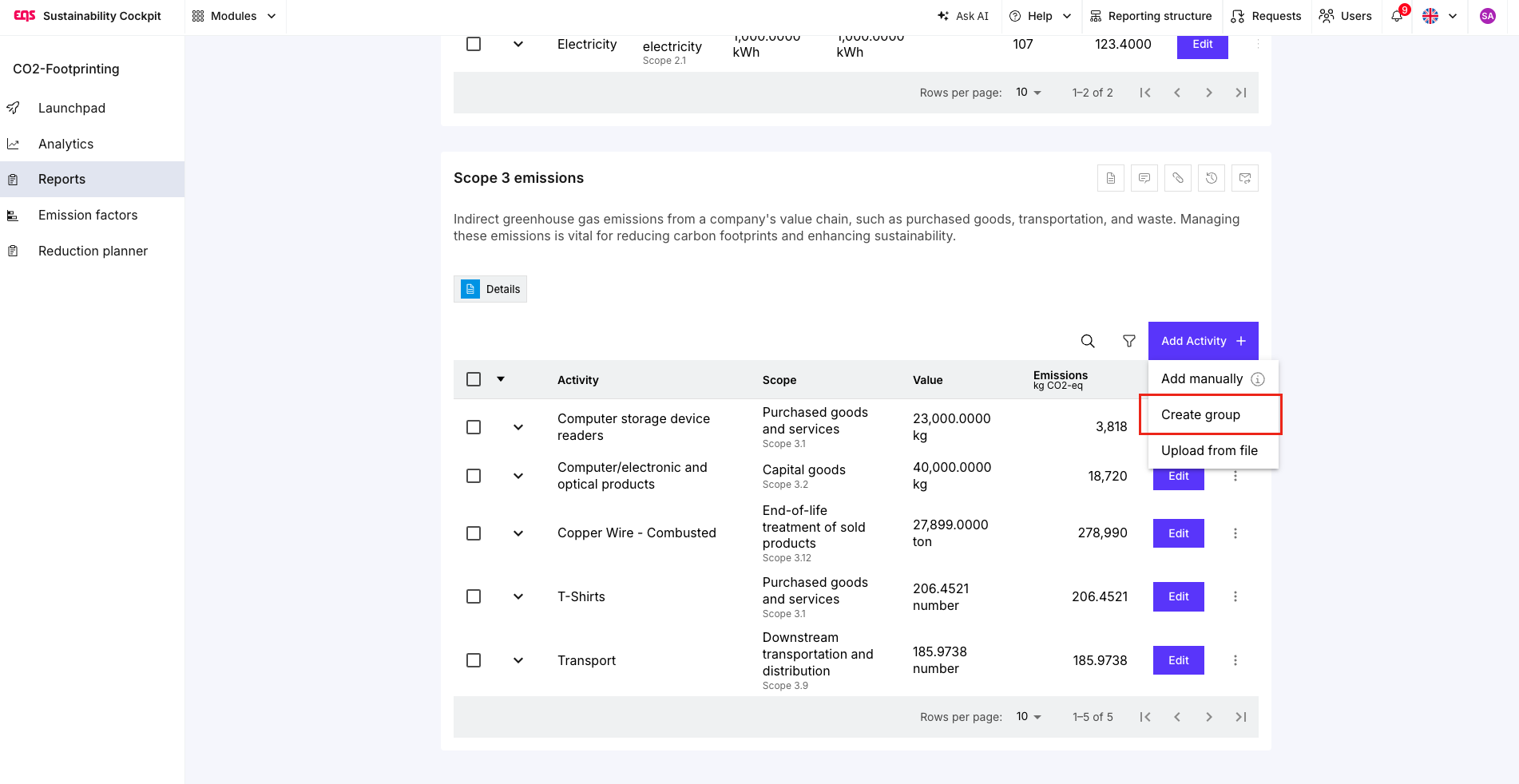
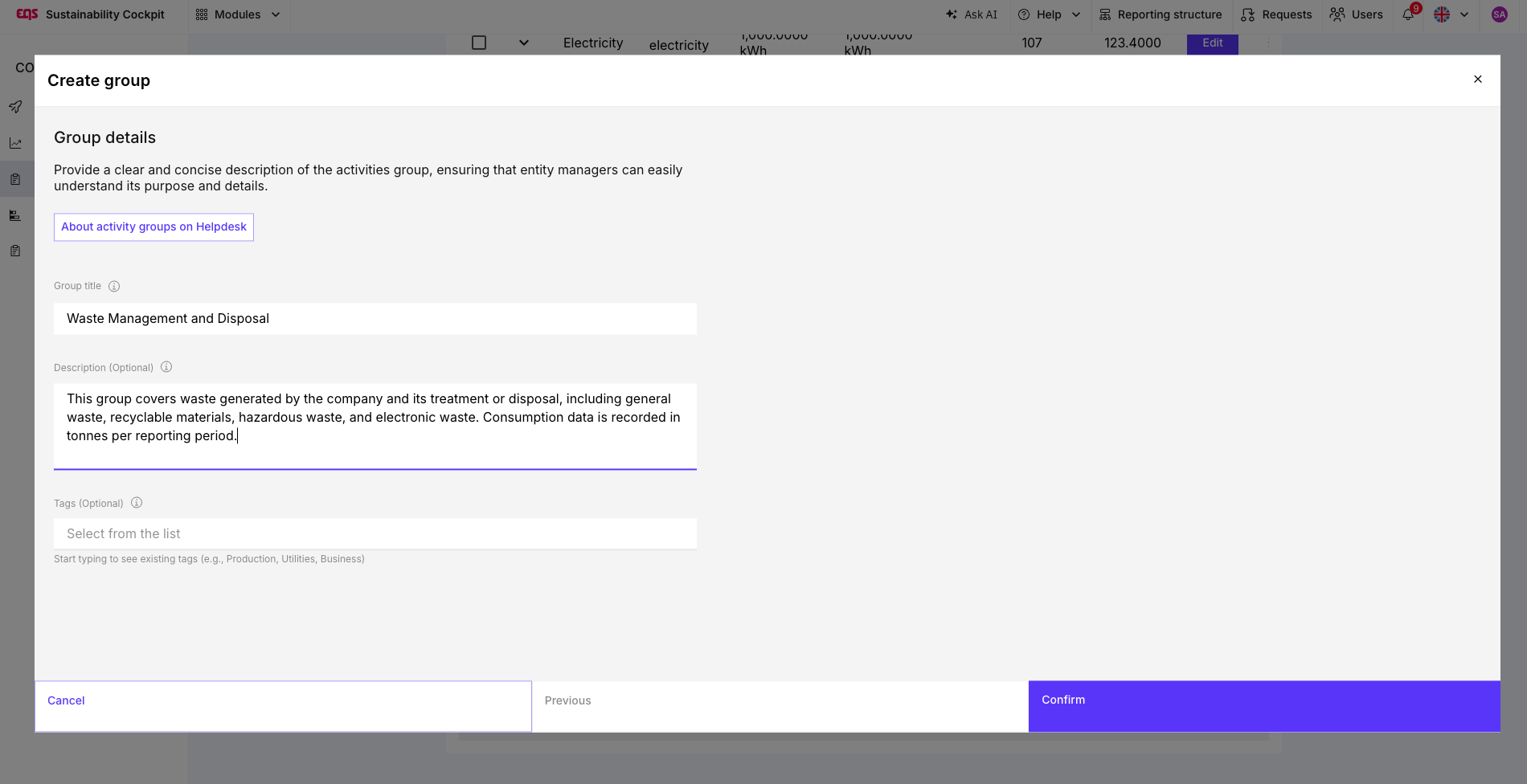
- Add the relevant activities manually or import them through an upload.
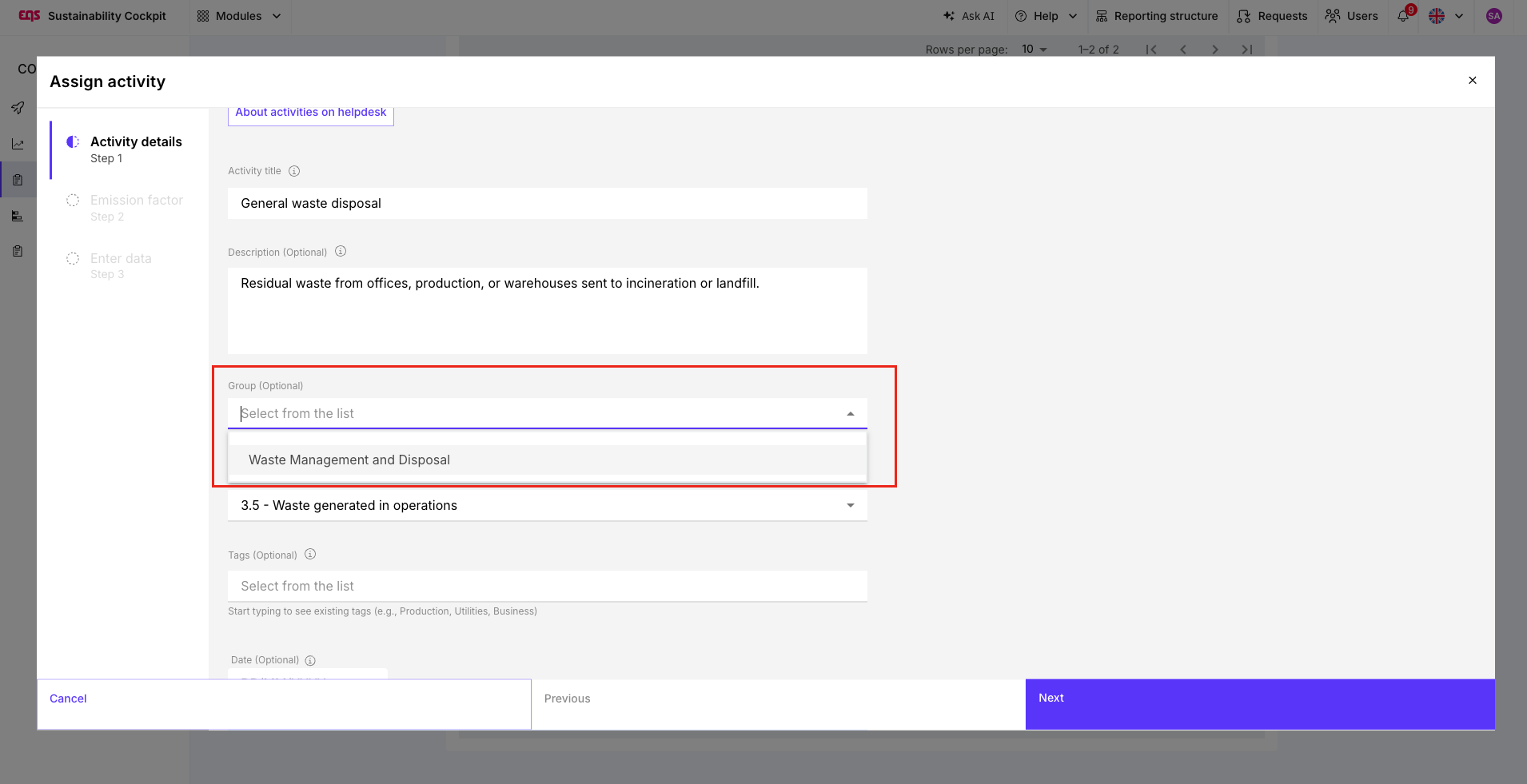
 Choose meaningful names that are easy for other users to understand, such as “Waste by Disposal Method” or “Packaging Product Line A” instead of “Other 2.”
How are group emissions calculated?
The emissions of the individual activities within a group are added together. The result is displayed as group emissions.
Example:
| Activity | Emissions |
|---|---|
| Bananas | 120 t CO₂e |
| Oranges | 80 t CO₂e |
| Kiwis | 50 t CO₂e |
| Group emissions “Imports from EU countries” | 250 t CO₂e |
Group emissions show the overall impact of a specific topic, product, site, or project at a glance.
Example: Waste activities by disposal method
A company wants to analyze its waste emissions within a Scope in greater detail. It creates the group “Waste by Disposal Method” and adds several independent activities:
- residual waste sent for incineration;
- paper and cardboard sent for recycling;
- organic waste sent for composting;
- mixed commercial waste sent to landfill.
Each waste activity can be recorded using its own emission factor and an appropriate calculation basis. The activities are initially calculated separately. The system then adds the respective emissions together and displays the total emissions for the group.
Example:
| Waste activity | Emissions |
| Residual waste sent for incineration | 18 t CO₂e |
| Paper and cardboard sent for recycling | 4 t CO₂e |
| Organic waste sent for composting | 2 t CO₂e |
| Mixed commercial waste sent to landfill | 11 t CO₂e |
| Group emissions “Waste by Disposal Method” | 35 t CO₂e |
This structure allows the company to analyze both the emissions of individual disposal methods and total waste emissions. It also makes it possible to identify which disposal method contributes most significantly to the overall emissions.
Was this article helpful?
That’s Great!
Thank you for your feedback
Sorry! We couldn't be helpful
Thank you for your feedback
Feedback sent
We appreciate your effort and will try to fix the article